Showing posts with label Jane Austen Drinking Game. Show all posts

Saturday, December 28, 2013

JADG - Womanly Skills

It's the last category for the Jane Austen Drinking Game - Womanly Skills! As I have covered those topics before, I will offer up Minerva and Dolly's passion for geography.

When I was in 5th grade, about 10 years old, my social studies teacher had us draw freehand maps, which I loved doing. With all the lines of latitude and longitude in place, I would draw in the boundaries, and then with colored pencils, fill in all the rivers, mountains, and other landmarks, cities and roads, and then make a beautiful legend and compass rose. I wish I had kept my map of New England. It was the best in the class.

Much more recently, I found that this exercise was the foundation for geography education in the 19th century. It utilized art and penmanship skills while the student learned geography. I am amazed that these are usually in bound school notebooks, meaning the student did not make mistakes and have to tear out any page. There is a wonderful assortment of what are referred to as "schoolgirl maps", the surviving work of students from the early 1800s. Boys did this exercise as well, but as is common, the females tended to keep their school notebooks tucked away in a trunk or attic, and pass them on to descendants. Frances Henshaw's notebook is especially beautiful. I took a copy of her map of Vermont and pasted it in the inside of a student desk I refinished a few years ago.


Here, Dolly and Minerva are updating their maps, due to recent explorations of the American west by Lewis and Clark.


Friday, December 27, 2013

JADG - Gout and Decrepitude

The caricature prints of the Regency Era really make a feast of the infirmities of the older generation, particularly if they are rich. Thomas Rowlandson's prints, The Comforts of Bath are full of fat, gouty men being hauled to the Pump Room in sedan chairs or handcarts to take advantage of the supposed health-giving quality of the mineral springs. And then stuff their faces with the rich food and wine that made them fatter and goutier. My dad has had periodic bouts of gout, and it sounds like a very painful condition. I showed him this print, and he said it was pretty spot on. Fortunately,we have medication today that deals with the cause.

Those people who managed to live to a ripe old age, were often much less than "ripe". It was a rare individual who was not plagued by all sorts of infirmities and no medical help available. One's prime was over very quickly in those days. Young women in search of a good husband lived in fear of some aged wreck taking a shine to them. Among the nobility or those who aspired to raise their standing, a proposal from a wealthy and titled old man was a prospect too good to pass up when they had a marriageable daughter.

Poor Evelina is being pursued by the obnoxious Dr. Syntax, a man who is impervious to hints or even blatant refusals. Dr. Syntax was a character created by the artist Thomas Rowlandson and the poet William Combe, a ridiculous elderly curate who set off on his horse to tour the countryside, falling into one absurd situation after another. The poems and prints were shown to Rudolph Ackermann, who was quite enthused and, after removing a few of the more racy pictures, agreed to print them. The Three Tours of Dr. Syntax was extremely popular in the early 1800s.


Thursday, December 26, 2013

JADG - Failure to Preserve Distinction of Rank

The day after Christmas: the perfect time to gather in front of the TV and watch some Jane Austen movies, and of course, play the Jane Austen Drinking Game. We're up to Failure to Preserve Distinction of Rank, and when that happens, it could mean the End of the British Empire As We Know It. Well, look what's happened to that in the last 100 years.

In spite of; indeed, because of the trend in the 1800s of just anyone being able to become very wealthy and/or educated, those who inherited their importance by way of feudal lands and titles had to work extra hard to keep everyone reminded of the fact they they were The Upper Class and The Nobility. A dirt-poor person with a title was a gentleman, while someone who had made millions through industry was an upstart. Failure to give that gentleman his due was a huge social blunder.

Dolly and Minerva are visiting the palatial home of Lady Wrattle, and Minerva, just as I would do, has brought along a book, in case things get dull.


Tuesday, December 24, 2013

JADG - News of Bodice-Heaving Import

In every Jane Austen movie, some news arrives which causes great consternation or jubilation among the ladies. Between all the excitement and the tightness of some corsetry, bosoms heave, which results in women fanning themselves rapidly and sinking into chairs. In the Jane Austen Drinking Game, the arrival of such news, the heaving of bodices, and the use of the word "import", all deserve a drink.

One of the things I love about Regency era clothing is the more sensible undergarments. Women did wear corsets, but only to achieve a smooth appearance. Without a defined waistline in clothing (another plus for me), there was no need to squeeze the body into an unnatural shape. From around 1800 to 1830, undergarments kept the bust in place (up!) and everything else under control. I enjoy watching the newer Austen movies and observing the costuming. Particularly during dancing scenes, when the body is in motion, one can see the outline of the corset under the gown. This is a very unstructured corset from about 1810, suitable for a slimmish figure. One of the favorites for modern Regency costumers to make is this bra-style garment. It's all that's needed for slim young women. If a bit more control is needed, there's this model, still quite comfortable.

By 1830, all naturalness was gone: suddenly, wide shoulders, a tiny waist, and wide skirts were the rage, and women laced up to pull in the midsection. It was an awful trend that continued into the next century. That's when women carried smelling salts in pockets and purses, and divans and recamiers were called "fainting couches". Smelling salts were aromatic substances mixed with ammonia salts, put in small bottles, and waved under the nose of a fainting person. A good whiff of ammonia will perk you up right away!

It looks like a three-drink day for the Ackermann girls!


JADG - Gallant Men

Gone are the days of curtseys and bows. The only time I've done a curtsey or received a bow is in square dancing or contra dancing. My parents were first generation Americans, their parents having immigrated to the US during the big influx through Ellis Island, so many people of my grandparents' generation were Europeans with formal manners. "Gentlemen of the old school" was the saying, before some rap artists ganked the term, and applied it haphazardly. Mom spoke of elderly men who would stand up and bow when she came into the room, and a few who would actually kiss her hand, much to her embarrassment. I still think poorly of men who do not remove their hats indoors, although I don't expect them to tip their hats outdoors. Courteous manners bowl me over. It's one thing I noticed when living in the South, that men still had a touch more of the traditional manners, and treated women with more (sad to say) old-fashioned courtesy than in the North. Having lived through those decades where women got all up in men's faces about opening doors and such, I feel sorry for women who don't appreciate what we used to call "common courtesy".


Monday, December 23, 2013

JADG - Flowering Into Womanhood

Flowering into womanhood sounds so lovely, but as women know, it's not all that wonderful. First of all, there's that monthly thing, which is so looked forward to. Pretty soon that thrill wears off, and the next 40+ years seems like extreme overkill in the name of fertility. All cultures have their ritual observances of this event in a girl's life, usually emphasizing the idea that she is now looking forward to using all that fertility.

Coming out in society meant that a young lady was available to meet eligible men and hopefully marry one of them.  Usually, girls were at least 16. In Pride and Prejudice, the erratic Mrs. Bennett ignored that aspect, and considered all her girls introduced into society, mainly because she couldn't see leaving the younger girls at home while the older ones went to dances and parties. Of course, everyone thought she was completely irrational, and they were right.


Sunday, December 22, 2013

JADG - Realization of True Love

Chug Time on the Jane Austen Drinking Game! Ah, the realization of true love! All the heart palpitation, sweaty palms, churning stomach, absent-mindedness, or whatever reaction humans are prone to when they fall in love. When two people actually fall in love with each other at the same time, what a physiological and psychological assault it is.

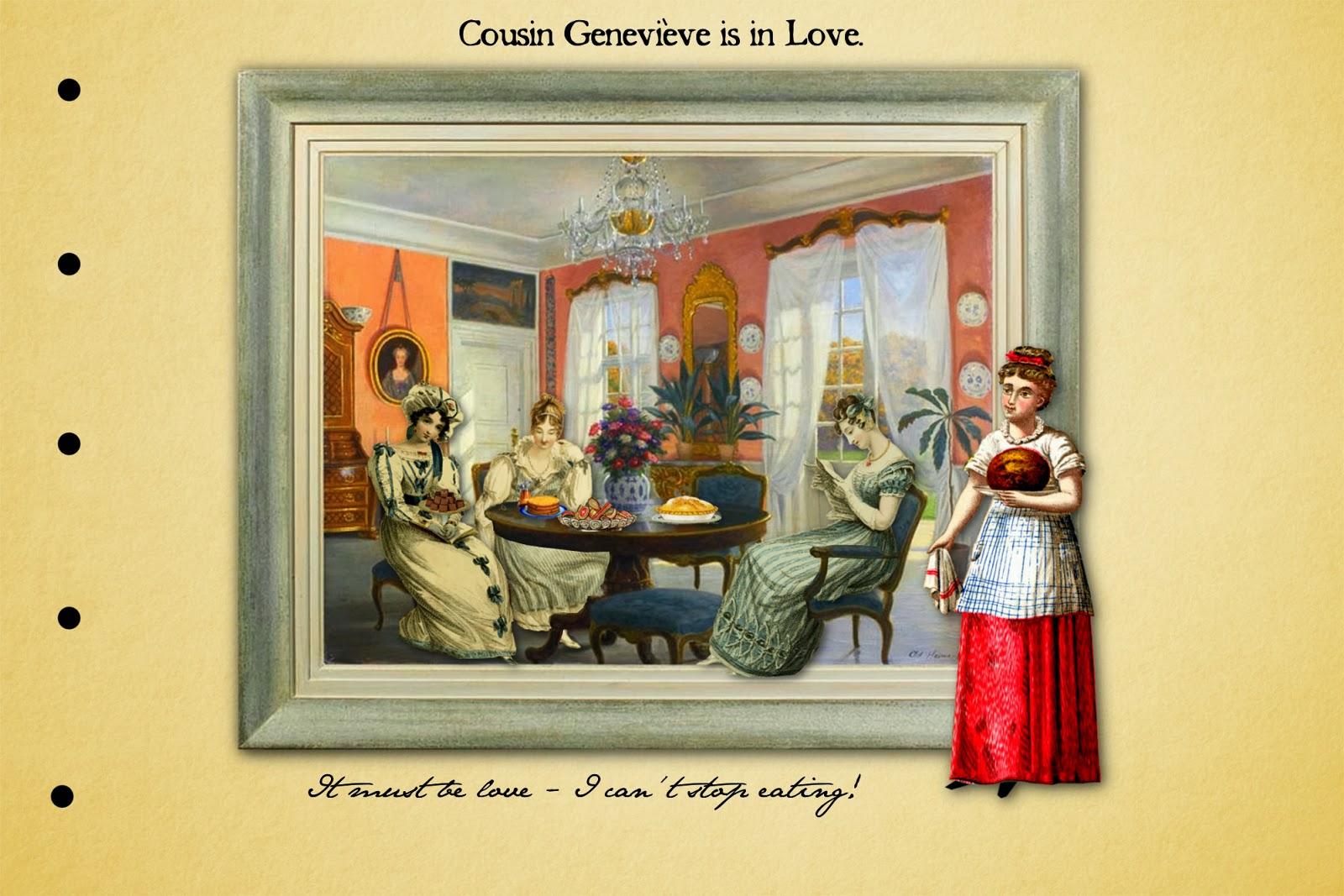
Cousin Geneviève has been in the company of Louis for some time now. Remember the handsome son of the friends of Sir Percy Blakeney? He fell for her like a load of bricks and quickly set about to winning her heart.  It looks like he's succeeded.


Saturday, December 21, 2013

JADG - Retention of Countenance

It may be two drinks for loss of countenance, but keeping one's cool in the face of horrible events, slanderous attacks, or devastating news is a three-drink category in the Jane Austen Drinking Game. Retention of countenance is almost always a challenge directed at women, while men could vent their emotions much more freely, and appear more manly for it. 

The late18th century poet Mary Robinson lamented that women were so repressed in the expression of their emotions. "The heart must love," she wrote in her Memoirs, "or it will be dead to every noble, every sublime propensity." But in order to survive in the world arranged by men, she continued, a woman must learn to  be "a calmly thinking being, who can weigh the affections of the heart against the proprieties of Reason." Robinson herself fought a hopeless battle against her public reputation, as a former actress and one-time mistress of the young Prince George. A stunning beauty, she also had a brilliant mind, gaining the admiration and sincere friendship of some of the great thinkers of the day. Samuel Taylor Coleridge, a close friend, called her "a woman of undoubted genius". She wrote plays and novels (not very good ones), but became most well-known for her fine poetry. Her writing became the outlet for her ideas and her deep feelings, and through them she hoped to "remake" herself, as is the modern trend, and literally overwrite (double pun there) her former reputation. Unfortunately, for the next 150 years, that reputation overshadowed all her work, and it was not until the latter half of the 20th century that Mary Robinson, poet, was valued without mention of "Perdita", the role in which the Prince of Wales became besotted with her.

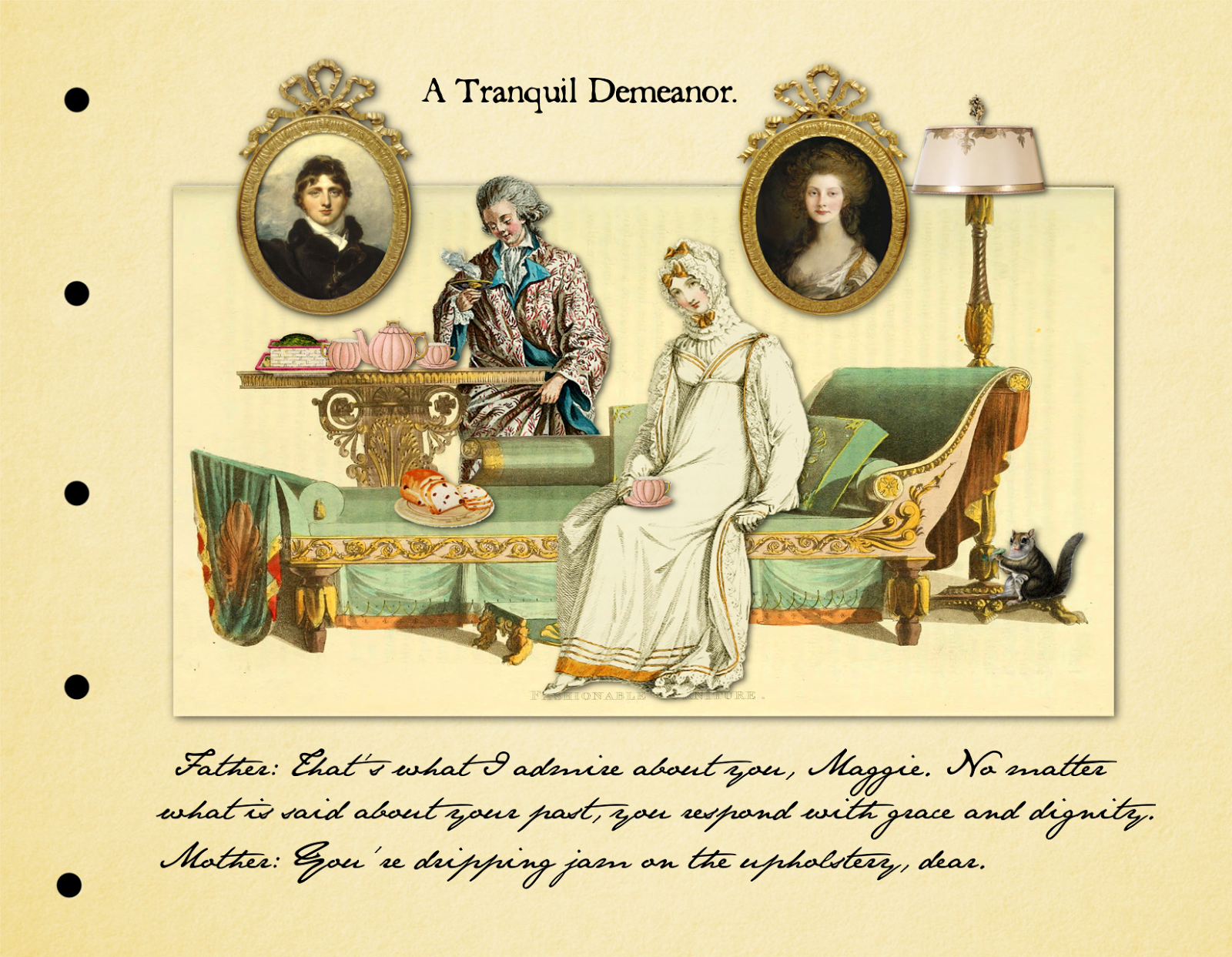
There's something about Mother Ackermann's past that makes her an enigmatic figure. Always calm and wise, she occasionally pops out with a comment that makes one wonder what's going on in her mind. The portraits of the Ackermanns in their youth are actually Lord Granville Leveson-Gower, 1st Earl Granville, and Princess Augusta Sophia Hanover, daughter of George III. They had nothing to do with each other in real life.


Thursday, December 19, 2013

JADG - Loss of Countenance

We're up to the "two drinks" level on the Jane Austen Drinking Game! Loss of countenance was a big no-no in Austen's world. Keeping a straight face and one's emotions under control was a major sign of good manners, as is evident in just the title of Sense and Sensibility. I'm sure that most people today would not be able to explain the significance of those words in the context of the times. Sensibility was a full expression of what was received by one's senses. Marianne wore her heart on her sleeve and let her feelings rule over good sense, often to her detriment. In Pride and Prejudice, Mrs Bennett's "poor nerves" made life very wearing for everyone around her, even leading to Mr Darcy's opinion that the whole family were a bunch of kooks. Outbursts of anger, spontaneous professions of affection, or bursting into tears were a sign of an inability to rule over one's emotions and keep reason in charge.

One of my absolute favorite voices from the past is the British politician Edmund Burke (history nerd that I am). His speeches left his audiences with their jaws on the floor and his political essays cut right to the heart of contemporary issues in terms that knew no boundaries of time. He recognized full well the effects of the Enlightenment worship of Reason and the unchecked human emotion that had destroyed the philosophical foundations of the French Revolution. His book, Reflections On The Revolution In France, focused the blame on the "sensibility" of Rousseau, as opposed to the "natural feelings" of mankind, based on sound moral principles. A good free Googlebook, if you are so disposed, is Peter Stanlis' Edmund Burke: The Enlightenment and Revolution

An acquaintance of Mother Ackermann is well-known for her wild outbursts.


Wednesday, December 18, 2013

JADG - Small Dogs

We love our dogs, and those little, tiny, miniature, teacup, lap dogs are soooo cute! Small dogs are really quite ideal. They take up such little space, don't eat much, can be carried easily, and won't crush you when jumping up. That's why you rarely see those dogs at the animal shelter. Everyone gives away the darling puppy that grew into a wolfhound, unless the dog is so weird they can't get attached to it. My sister got a Chihuahua/Raccoon/Hyena mix dog at the shelter and he is the love of her life.

As long as painters have been painting women, they have been painting small dogs with them. Many Ackermann fashion plates have included those little pets, who are obviously well-loved. One drink per dog!


Tuesday, December 17, 2013

JADG - Spontaneous Equestrianism

In the "one drink" category of the Jane Austen Drinking Game we have men leaping on to or off of horses to relay news of great import. With a clattering of hooves, scattering of gravel, and whinnying of a protesting steed, some impetuous male would be off to deal with some important business, usually in London.

I recently heard on the radio a sad anecdote from the early 1800s. Samuel Morse, a famed painter, was commissioned to paint the portrait of the Marquis de Lafayette, who was visiting in Washington, D.C. Morse traveled from his home in New Haven, Connecticut, over 300 miles, leaving behind his wife who was soon expecting a child. While working on the portrait, a rider arrived with a letter informing him that his wife was "convalescent". He prepared to leave, but not before another letter reported his wife's unexpected death. He rode hard, day and night, but did not arrive home until after her burial. It was then that Morse began to focus on a way that messages could be transmitted more quickly, sparing others such heartbreak. Over the next 20 years, he worked on a method of transferring electromagnetic signals through wires - the telegraph - using an alphabetic system of clicks - the Morse Code. Of course, receiving telegrams has become a symbol of heartbreaking news.


Monday, December 16, 2013

JADG - Conceited Independence

On with the Drinking Game!  No Jane Austen novel is complete without the young woman who just goes off and does something rash, usually ending up with mud-splattered stockings, ruined shoes, or a serious chill that develops into pneumonia. What were you thinking, foolish girl?

An interesting series of Ackermann prints are the Poetical Sketches of Scarborough, etched by the well-known artist Thomas Rowlandson. Scarborough was one of the many popular seaside resorts of the late 18th-early 19th centuries, but Rowlandson's pictures show a place I would avoid completely. If  it's not dumping buckets of rain and blowing up a storm, the sky is gray and heavily overcast. Visitors arrive in the rain, struggle up the beach through strong headwinds, and line up in the drizzle to see tourist attractions. Some misguided girls plan a picnic on a wind-battered beach, only to find themselves caught in a furious thunderstorm. If that wasn't bad enough, Cousin Delphine, always the independent spirit, decides to take off in search of assistance. What good can come of that, Delphine?


Thursday, December 12, 2013

The Jane Austen Drinking Game -- Dowries


After seeing this skit a few years ago, we Austen fans in the family could never see one of her movies without continually calling out categories and raising imaginary glasses to our lips. Ah, the themes of Austen's world come up again and again, instructing us how important and ubiquitous they were in her times, and how much society has changed since then. So let us, and Dolly and Minerva, go through them, shall we?

The whole concept of dowry and bridewealth seems, at very least, degrading to the modern mind, although it continues to be practiced in many cultures around the world. It's interesting to see which cultures have adopted the dowry system (in which the woman brings goods to the man or his family) or the bridewealth system (in which the man brings goods to the woman and her family). It's also horrifying to see how dowries have become the root of terrible violence and abuse of brides, particularly in present-day South Asia. If we can abandon the modern mindset that the woman is being bartered in some fashion, they each have their merits.

In bridewealth cultures, the man must offer the woman's family a substantial amount of property in order to marry her, the rationale behind this being that the family is losing a valuable contributing member. This was common among North American native nations, as was reported by white "mountain men" who took native wives, and were required to come up with hefty gifts of horses, blankets, and such items. It is still common in many parts of Africa, where men must purchase cattle to offer to the woman's father.

The original purpose of a dowry was for her family to give her something to bring into her marriage in order to set up a home and have something to fall back on in case the marriage did not work out. It was also her inheritance, given to her as she left her family, rather than at the death of a parent. In Islam, a woman brings property into the union, but in case of divorce, she is entitled to take it with her. However, as laws or custom concerning women's property throughout the years have not been favorable to women, dowries became the property of the husband to do with whatever he wished. The higher up in society one went, in Regency times as an example, the more mercenary this trade became. The Prince Regent's marriage to Princess Caroline of Brunswick was nothing more than a way to pay off his looming debts with her dowry. In Jane Austen's social class, an inadequate dowry could seriously hamper a girl's prospects of landing a man of an equal or better standing.


The September 1813 issue of Ackermann's Repository has an interesting article on the question of dowries among the wealthy class. The author is definitely against the custom, but his solution (to forbid them altogether) ignores the most obvious remedy, to legislate equitable inheritance and ownership laws.