The early 19th century saw the practical applications of the steam engine to transportation. Steam-powered locomotives pulled lines of rail cars from factories to ports where goods were loaded onto ships bound for other ports. Boats that had been pulled up canals by horse or mule were now steam-driven. Despite the immense benefits steam engines provided, they contributed greatly to air and noise pollution. Just a look at the picture below will give you an idea how filthy passengers in the coach car could become.
Showing posts with label Currier and Ives. Show all posts
Monday, February 24, 2014
Sunday, February 23, 2014
Farewell Party at John I's.
In the mid-1800's, Snedecker's Roadhouse in Brooklyn, NY was the place to go. Next to the Union Race Track, it attracted the lively racing crowd. The big draw to Snedecker's, or John I's, as its devotees called it, was during the winter sleighing season. According to this article, fresh snowfall was a signal to the sleighing crowd to make the 8-mile trip from the city to enjoy the winter ride and a fun party at Snedecker's. It's hard to imagine the landscape at that time -- open fields and scattered farms. This article chronicles the downward slide of the site, ending with a photo of a 1770 farmhouse that was demolished in the 1920s.
Saturday, February 22, 2014
Fraternal Societies in the 1800s
The 19th century was an active time when it came to fraternal societies, those clubs which incorporated men's night out with social activism and a large dose of all the arcane ritual of boys who are allowed in the tree house. Being in a family with dedicated Freemasons, I am often reminded of Tom Sawyer, who could never do anything without incorporating a framework of symbolic meaning, incantations, and literary inspiration. Fraternal societies have dwindled in number and membership over the last century, as modern entertainment and demands on free time have rendered them almost obsolete. My aged dad belongs to a rural lodge that meets on or before the full moon of every month. Musing about this, I asked him if there was any ritual significance connected with the lunar cycle, or was it just so that farmers using horses and wagons would have a bright moon to light their ways home. He laughed and said it was definitely the latter, and more practical, option.
Dolly and Minerva return to the Currier home where the quadruple twins are beginning to give them an uneasy feeling.
Wednesday, February 19, 2014
On The Right Track.
Walking home from the gallery, Dolly and Minerva pass by Lover's Lane, and spy courting couples strolling and gazing calf-eyed into each other's faces. Obviously, this is a precursor to the happy family they hope to have one day, but it does seem rather forward to follow these young lovers around until children start appearing.
Saturday, February 15, 2014
Sugar On Snow.
In maple country of North America, sugaring season is an important time. When the nights are freezing and the days are warm, the first fresh sap runs up through the maple trees. By drilling a hole through the bark and inserting a small spout, sugar makers are able to draw off large quantities of sap. The clear sap is then boiled until evaporated down to 1/40th of its volume, to a golden brown syrup. Boiling it further reduces it to a granular sugar. A traditional treat is to boil maple syrup to the "soft candy" stage and dribble it on a pan of fresh, clean snow, where it cools to blobs of sticky candy. It's extremely sweet, so it is always served with hot coffee, fried doughnuts, and pickles.
Here, Dolly and Minerva have been invited to such a party. They didn't expect the rough setting, as you can tell by their choice of dress.
Wednesday, February 12, 2014
America's Pastime.
In their search to understand men, the girls find themselves following a great crowd of men to a sporting event in a large open field. It involves a man with a large stick who attempts to hit a small ball and run from point to point around a quadrilateral path and return to his original place before someone catches said ball and touches him with it. Which everyone in the field is keen on doing. Great excitement!
Monday, February 10, 2014
Firefighters
Between 1854 and 1866, Currier and Ives released a series of prints on the subject of firefighters, those brave volunteers who leap up at any hour, haul out fascinating machines, and race off to protect life and property. The main action pictures, with stirring titles, are as follows:
"The Life of a Fireman. The Fire, 'Now then with a will- shake her up boys.'"
"The Life of a Fireman. The Metropolitan System."
"The Life of a Fireman. The new era. Steam and Muscle."
"The Life of a Fireman. The night alarm.-'Start her lively boys'."
"The Life of a Fireman. The Race,-'Jump her boys, jump her!'"
"The Life of a Fireman. The Ruins - Take up - Man your rope."
Other prints were included, showing less grand action, but more personal portraits of dedication and bravery. Dolly and Minerva are quite impressed with some local firefighters, as women will be far into the future.
Sunday, February 9, 2014
A Man's Life
Back at the house, Hiram and Homer begin recounting the day's adventures with Mr. Smith, while Horace cleans his fish in the kitchen. Mrs. Smith offers sage advice to Dolly and Minerva.
Saturday, February 8, 2014
The American Wilderness
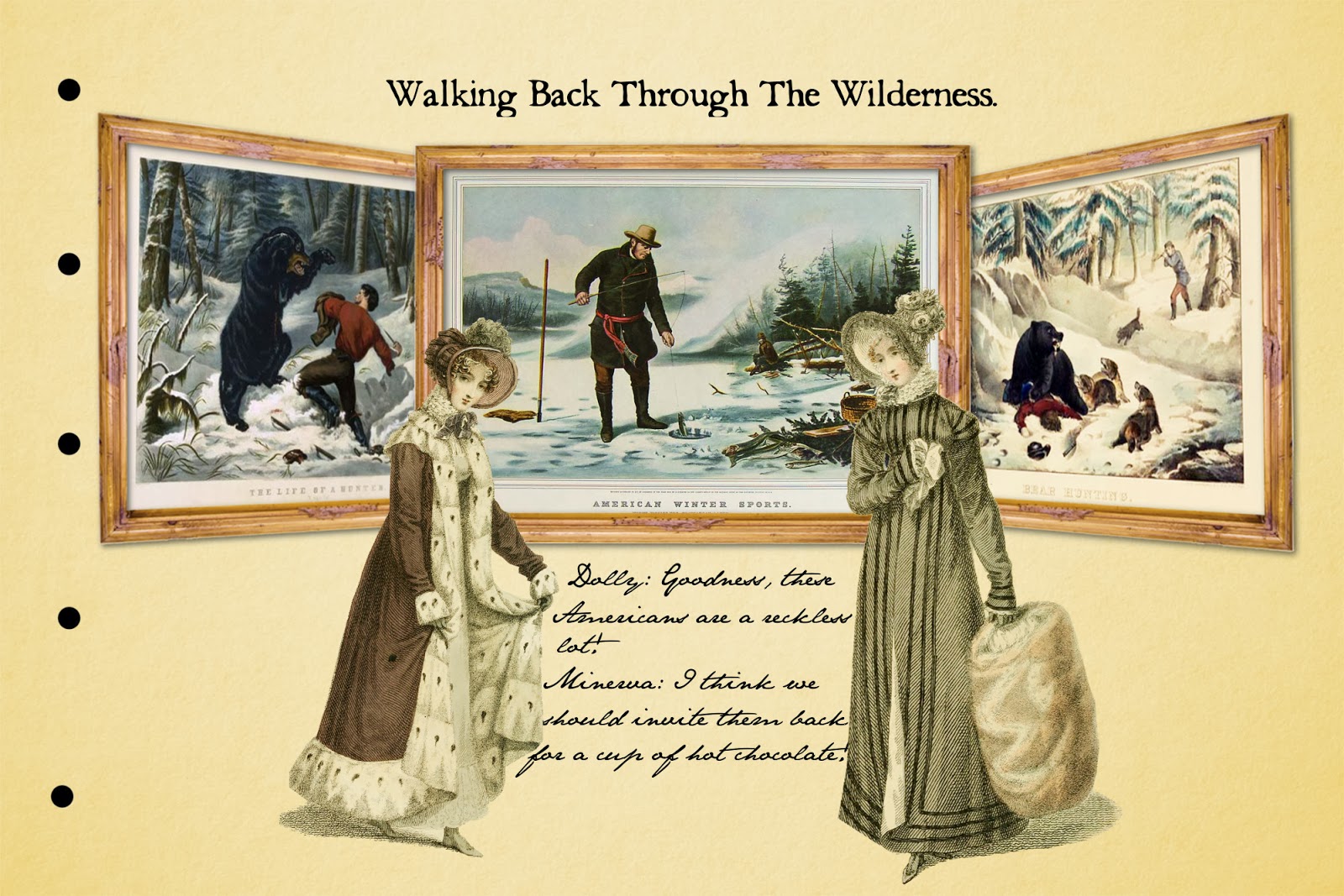
Abandoning their sleigh, Dolly and Minerva walk back to the grandparents' house to sit by the fire and enjoy a cup of hot chocolate. On their way, they observe men engaged in rugged outdoor pursuits. American men seem to thrive on dangerous, life-threatening activities. For the rest of his long life, Hiram will tell the story of shooting that bear in the nick of time, while Homer proudly displays the jagged scars of his ordeal.
Friday, February 7, 2014
Jingle Bells
Dolly and Minerva had seen a jolly group in one-horse sleighs racing past the window, and in no time, they were seated in such a vehicle, flying over the snowy roads. This was a very popular past time in pre-automobile days and still is among the few who actually own a sleigh and a horse. But as the song goes, it's very easy to get "up-sot"! How many painful and/or fatal accidents must have happened because reckless young men felt more than up to a challenge.
Thursday, February 6, 2014
Serendipity: or Going The Wrong Way, But Enjoying The Trip
Dolly and Minerva explore the Currier and Ives series, The Four Seasons of Life, in their search to find out how all these happy families, crammed with adorable children, came to be. It looks like they've wandered into Old Age, which depicts a contented elderly couple with a sweet little grand-daughter at their knees. Grandpa is regaling little Lizzie with tales of how things were in his day, while Grandma goes on about how handsome Grandpa was in his youth. Lizzie is swallowing very little of it.
Minerva is ready to backtrack through the series when Dolly notices a jolly, jingling group of sleigh-riders pass by on the snowy road. This could be fun!
Tuesday, February 4, 2014
Visiting A Family
Dolly and Minerva are taking Mr. Ackermann's advice and broadening their horizons. Mother has suggested a trip to America to visit the Currier and Ives prints. They are having a pleasant stay with a happy family with four energetic children. Hopefully, they will get to the bottom of this baby business!
Sunday, February 2, 2014
Thursday, October 31, 2013
Acceptable Sports for Females #4: Ice Skating
The Winter Olympics always had my family glued to the TV set when I was growing up. Skiing was the backbone of our local economy, Dad worked at a ski area, and ski lessons were part of our school program. The Olympic sport I loved watching the most was figure skating -- the strong and graceful athletes who seemed to defy the force of gravity, with the little remnants of their costumes fluttering as they flew. I never skated as a child, because in our region, any open water was in the form of twisting brooks that flowed downhill over glacial boulders and fallen trees. It would freeze up in great jagged lumps and piles of thick floes. No one seemed to care enough to keep snow cleared off the wider river down in the village.
Ice skating has been a popular pastime and method of transportation for thousands of years, it seems. Holland, with abundant flat stretches of flooded land, was famous for ice skating. By the 19th century, skating was an accepted activity for women, although most pictures depict men skating and women watching them make fools out of themselves. Currier and Ives made a number of popular skating prints, ranging from fun on the farm to vast throngs of jolly urbanites crowding the ice at New York's Central Park.
Most of the fancy footwork and amazing leaps of today's figure skating was developed by competitive and exhibition skaters much later in the 19th century. Some of these skaters were Axel Paulson, Alois Lutz, and Urich Salchow. Names sound familiar?
Tuesday, October 22, 2013
Acceptable Feminine Sports in Georgian England: #1. Archery
I am not much of a sports person. Alright, I'm hopeless at sports and I don't much care, so the limitations on physical activity for women in Georgian high society would not have bothered me much. I would have been content to sit, shaded by my parasol, watching the young men prance about, displaying their feats of strength and sweating. Sports for women, such as they were, were established by necessity, such as being able to ride a horse well and gracefully, or sports in which women appeared elegant and poised. The loose, lighter clothing styles during this era enabled women to be much more active, and many of them must have longed to indulge in some seriously energetic physical activity. Many of Ackermann's fashion plates show women in "walking dress", or garments suitable for seaside strolls. Seawater baths were becoming popular, and many women, including Jane Austen, were fond of a brisk swim in the waves.
One particularly popular feminine sport was archery. Archery built up strength and promoted good posture. Moreover, women looked lovely while they pulled the bowstring back. In their long, white gowns, they conjured up the perfect classical image of Diana the Huntress. Many archery clubs sprang up during 1780s, and soon after, some began accepting women as members. One in particular, the Royal British Bowmen, was the first in that regard. A serious competitive group, the RBB viewed the presence of women as a deterrent to male members who were less devoted to improving skills and more inclined to drink and carouse. Archery societies such as these were excellent venues for upper-crust young men and women to meet and socialize. The Gwyneth Paltrow version of Emma shows an archery scene, although Austen's book does not include it. It is a common activity, however, and in a movie, provides a much more interesting setting to this contentious dialogue than two talking heads on a park bench. Poor Emma is not hitting the mark on any level.
Sources: Adam Buck print, The Archers; Ackermann's Repository; Royal British Bowmen (link above); Currier & Ives lithograph, Indian Hunter; photos of wicker furniture.
Sunday, October 20, 2013
The Life and Age of Woman
As I wrote in a previous post, the firm of Currier and Ives was the most prolific maker of quality lithographic prints of the 19th century and the most recognized today. Much of our mental image of American life in those days comes from their pictures. Among their series is "The Four Seasons of Life", depicting happy, middle-class people enjoying Childhood, Youth, Middle Age, and Old Age. A less idyllic viewpoint is found in the pair called "The Life and Age of Man" and its partner, "The Life and Age of Woman". The baby begins the uphill climb to adulthood, going "over the hill" to a long old age. How many people in those days actually reached the less than ripe old age of 100? After looking at this picture, I would hope I wouldn't!
One bit of information I found very interesting is that a major artist for C&I was a woman, Frances Flora Palmer. She did the Four Seasons of Life series, as well as the grim "Life and Age" pair. Her true passion was landscapes and she painted great numbers of them; beautiful scenery which was usually a backdrop for dramatic action. Palmer painted the Mississippi steamboat series, American Life Series, Civil War battles, and many favorite winter scenes: in all, over 200 pictures. I am so glad she didn't do the simpering girl portraits or those weird kittens!
While strolling through the pages of C&I prints, Dolly gets sidetracked.
Saturday, October 12, 2013
Currier & Ives' White Kittens
Currier and Ives was the great print-making firm of the mid-1800s, and hardly a home existed without one or more of their framed prints. They published series of prints on interesting topics, ranging from American landscapes, domestic scenes, pretty girls, Civil War battles, seasonal activities, to simply cute pictures. How many Christmas cards have you received with a Currier & Ives winter scene on it? Dolly and Minerva have happened upon one of the series of playful white kittens, and of course, they have no idea what is going on.
I've been asked for more information on the girls themselves. Dolly has lighter hair and seems a bit more clueless than her sister. Minerva is the dark-haired sister who takes charge through force of personality, more than intelligence or accumulated knowledge. Dolly turns to Minerva for direction, and usually ends up none the wiser for it.
Subscribe to:
Posts (Atom)