In every Jane Austen movie, some news arrives which causes great consternation or jubilation among the ladies. Between all the excitement and the tightness of some corsetry, bosoms heave, which results in women fanning themselves rapidly and sinking into chairs. In the Jane Austen Drinking Game, the arrival of such news, the heaving of bodices, and the use of the word "import", all deserve a drink.
One of the things I love about Regency era clothing is the more sensible undergarments. Women did wear corsets, but only to achieve a smooth appearance. Without a defined waistline in clothing (another plus for me), there was no need to squeeze the body into an unnatural shape. From around 1800 to 1830, undergarments kept the bust in place (up!) and everything else under control. I enjoy watching the newer Austen movies and observing the costuming. Particularly during dancing scenes, when the body is in motion, one can see the outline of the corset under the gown. This is a very unstructured corset from about 1810, suitable for a slimmish figure. One of the favorites for modern Regency costumers to make is this bra-style garment. It's all that's needed for slim young women. If a bit more control is needed, there's this model, still quite comfortable.
By 1830, all naturalness was gone: suddenly, wide shoulders, a tiny waist, and wide skirts were the rage, and women laced up to pull in the midsection. It was an awful trend that continued into the next century. That's when women carried smelling salts in pockets and purses, and divans and recamiers were called "fainting couches". Smelling salts were aromatic substances mixed with ammonia salts, put in small bottles, and waved under the nose of a fainting person. A good whiff of ammonia will perk you up right away!
It looks like a three-drink day for the Ackermann girls!
Tuesday, December 24, 2013
JADG - Gallant Men
Gone are the days of curtseys and bows. The only time I've done a curtsey or received a bow is in square dancing or contra dancing. My parents were first generation Americans, their parents having immigrated to the US during the big influx through Ellis Island, so many people of my grandparents' generation were Europeans with formal manners. "Gentlemen of the old school" was the saying, before some rap artists ganked the term, and applied it haphazardly. Mom spoke of elderly men who would stand up and bow when she came into the room, and a few who would actually kiss her hand, much to her embarrassment. I still think poorly of men who do not remove their hats indoors, although I don't expect them to tip their hats outdoors. Courteous manners bowl me over. It's one thing I noticed when living in the South, that men still had a touch more of the traditional manners, and treated women with more (sad to say) old-fashioned courtesy than in the North. Having lived through those decades where women got all up in men's faces about opening doors and such, I feel sorry for women who don't appreciate what we used to call "common courtesy".
Monday, December 23, 2013
JADG - Flowering Into Womanhood
Flowering into womanhood sounds so lovely, but as women know, it's not all that wonderful. First of all, there's that monthly thing, which is so looked forward to. Pretty soon that thrill wears off, and the next 40+ years seems like extreme overkill in the name of fertility. All cultures have their ritual observances of this event in a girl's life, usually emphasizing the idea that she is now looking forward to using all that fertility.
Coming out in society meant that a young lady was available to meet eligible men and hopefully marry one of them. Usually, girls were at least 16. In Pride and Prejudice, the erratic Mrs. Bennett ignored that aspect, and considered all her girls introduced into society, mainly because she couldn't see leaving the younger girls at home while the older ones went to dances and parties. Of course, everyone thought she was completely irrational, and they were right.
Sunday, December 22, 2013
JADG - Realization of True Love
Chug Time on the Jane Austen Drinking Game! Ah, the realization of true love! All the heart palpitation, sweaty palms, churning stomach, absent-mindedness, or whatever reaction humans are prone to when they fall in love. When two people actually fall in love with each other at the same time, what a physiological and psychological assault it is.
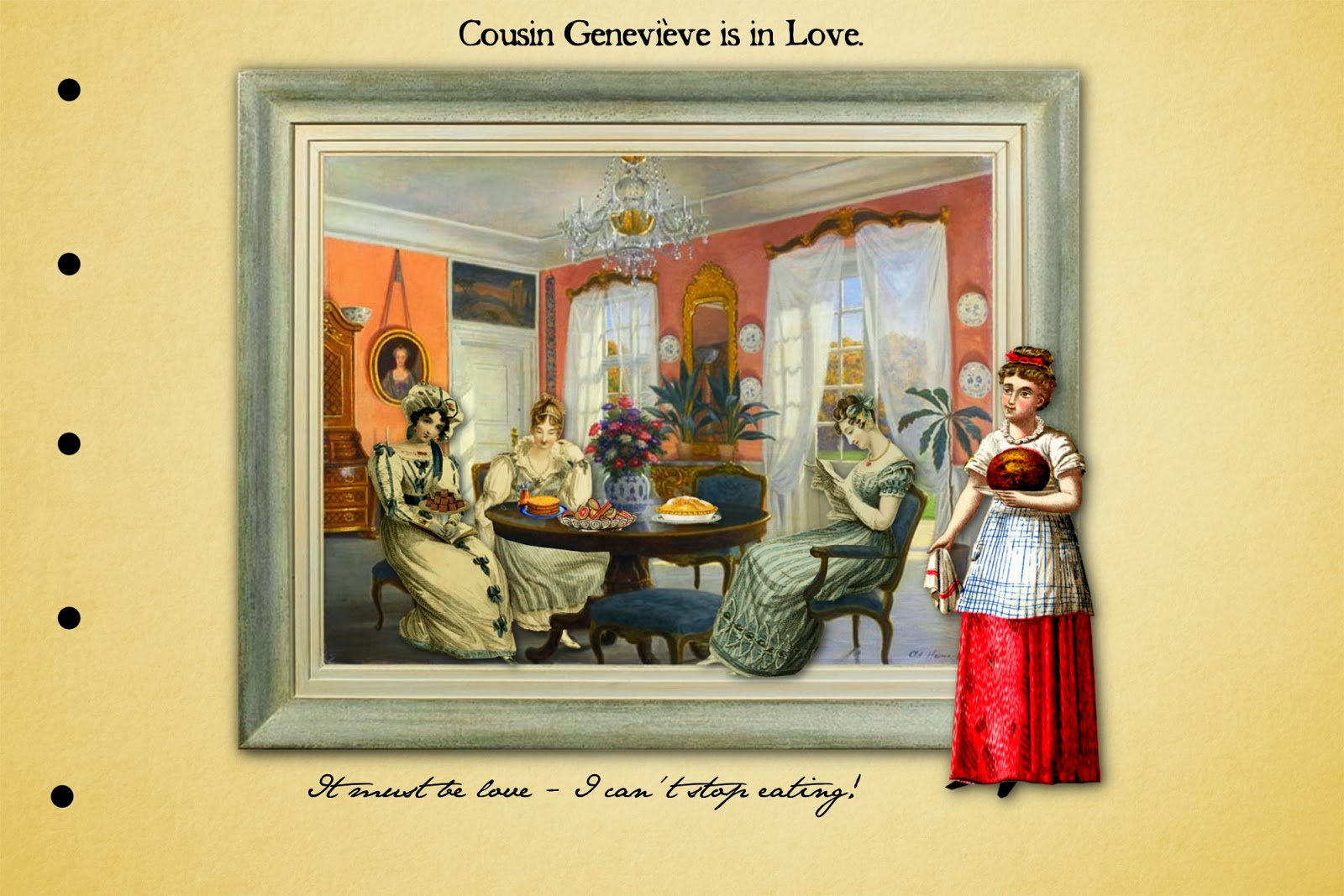
Cousin Geneviève has been in the company of Louis for some time now. Remember the handsome son of the friends of Sir Percy Blakeney? He fell for her like a load of bricks and quickly set about to winning her heart. It looks like he's succeeded.
Saturday, December 21, 2013
JADG - Retention of Countenance
It may be two drinks for loss of countenance, but keeping one's cool in the face of horrible events, slanderous attacks, or devastating news is a three-drink category in the Jane Austen Drinking Game. Retention of countenance is almost always a challenge directed at women, while men could vent their emotions much more freely, and appear more manly for it.
The late18th century poet Mary Robinson lamented that women were so repressed in the expression of their emotions. "The heart must love," she wrote in her Memoirs, "or it will be dead to every noble, every sublime propensity." But in order to survive in the world arranged by men, she continued, a woman must learn to be "a calmly thinking being, who can weigh the affections of the heart against the proprieties of Reason." Robinson herself fought a hopeless battle against her public reputation, as a former actress and one-time mistress of the young Prince George. A stunning beauty, she also had a brilliant mind, gaining the admiration and sincere friendship of some of the great thinkers of the day. Samuel Taylor Coleridge, a close friend, called her "a woman of undoubted genius". She wrote plays and novels (not very good ones), but became most well-known for her fine poetry. Her writing became the outlet for her ideas and her deep feelings, and through them she hoped to "remake" herself, as is the modern trend, and literally overwrite (double pun there) her former reputation. Unfortunately, for the next 150 years, that reputation overshadowed all her work, and it was not until the latter half of the 20th century that Mary Robinson, poet, was valued without mention of "Perdita", the role in which the Prince of Wales became besotted with her.
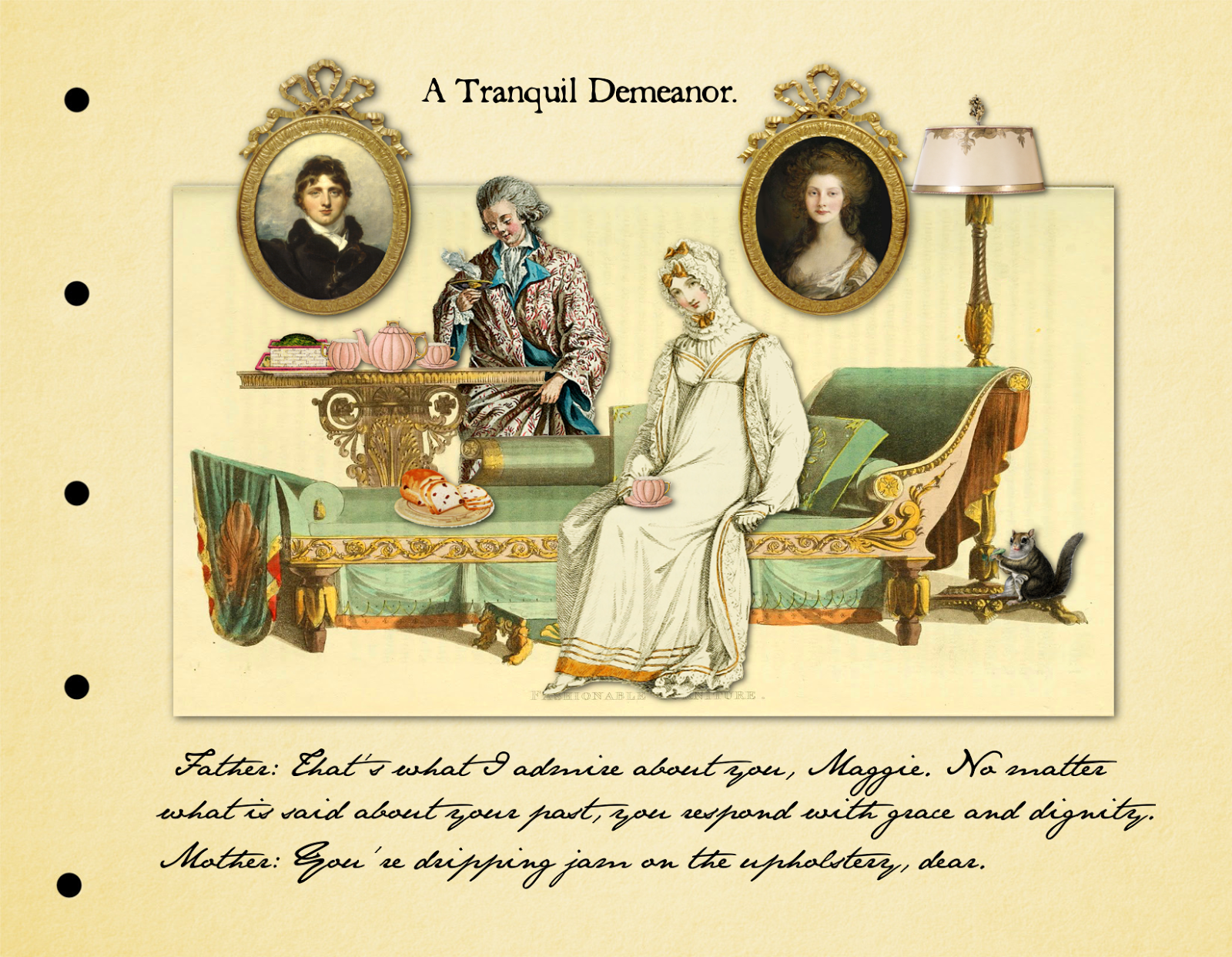
There's something about Mother Ackermann's past that makes her an enigmatic figure. Always calm and wise, she occasionally pops out with a comment that makes one wonder what's going on in her mind. The portraits of the Ackermanns in their youth are actually Lord Granville Leveson-Gower, 1st Earl Granville, and Princess Augusta Sophia Hanover, daughter of George III. They had nothing to do with each other in real life.
Thursday, December 19, 2013
JADG - Loss of Countenance
We're up to the "two drinks" level on the Jane Austen Drinking Game! Loss of countenance was a big no-no in Austen's world. Keeping a straight face and one's emotions under control was a major sign of good manners, as is evident in just the title of Sense and Sensibility. I'm sure that most people today would not be able to explain the significance of those words in the context of the times. Sensibility was a full expression of what was received by one's senses. Marianne wore her heart on her sleeve and let her feelings rule over good sense, often to her detriment. In Pride and Prejudice, Mrs Bennett's "poor nerves" made life very wearing for everyone around her, even leading to Mr Darcy's opinion that the whole family were a bunch of kooks. Outbursts of anger, spontaneous professions of affection, or bursting into tears were a sign of an inability to rule over one's emotions and keep reason in charge.
One of my absolute favorite voices from the past is the British politician Edmund Burke (history nerd that I am). His speeches left his audiences with their jaws on the floor and his political essays cut right to the heart of contemporary issues in terms that knew no boundaries of time. He recognized full well the effects of the Enlightenment worship of Reason and the unchecked human emotion that had destroyed the philosophical foundations of the French Revolution. His book, Reflections On The Revolution In France, focused the blame on the "sensibility" of Rousseau, as opposed to the "natural feelings" of mankind, based on sound moral principles. A good free Googlebook, if you are so disposed, is Peter Stanlis' Edmund Burke: The Enlightenment and Revolution.
An acquaintance of Mother Ackermann is well-known for her wild outbursts.
Wednesday, December 18, 2013
JADG - Small Dogs
We love our dogs, and those little, tiny, miniature, teacup, lap dogs are soooo cute! Small dogs are really quite ideal. They take up such little space, don't eat much, can be carried easily, and won't crush you when jumping up. That's why you rarely see those dogs at the animal shelter. Everyone gives away the darling puppy that grew into a wolfhound, unless the dog is so weird they can't get attached to it. My sister got a Chihuahua/Raccoon/Hyena mix dog at the shelter and he is the love of her life.
As long as painters have been painting women, they have been painting small dogs with them. Many Ackermann fashion plates have included those little pets, who are obviously well-loved. One drink per dog!
Subscribe to:
Posts (Atom)